
Stem Cell Regenerative Therapy
Soft tissue injuries and osteoarthritis are common conditions in dogs. These injuries are due to the forces placed on the joints and are more common in working dogs because of the repetitive injuries and microtrauma to tendons, ligaments, and articular surfaces. The degenerative arthritic changes progress throughout a dog’s life.
Most therapies treat symptoms or may slow the progression of osteoarthritis. Stem cell therapy treats symptoms, slows the disease, decreases pain and consumption of pain medications, and repairs some or most of the damaged tissue. It will improve a Service/Assistance Dog’s quality of life.
What are stem cells?
A stem cell is characterized by its ability to divide and create another cell like itself and by its potential to become many different types of cells. There are two broad types of stem cells:
Embryonic stem cells – Found in a developing embryo, embryonic stem cells are intended to form a whole animal or organ and have unlimited potential of development into any type of tissue. In human medicine, ethical and legal debates surround the use of embryonic stem cells for research and therapy; such controversy does not exist with the use of adult stem cells.
Adult stem cells – Found in most adult tissues, adult stem cells act as a repair system for the body, replenishing specialized cells and maintaining the normal turnover of regenerative organs, such blood, skin, or cartilage. Adult stem cells are also multi-potent, meaning the cells have the potential to differentiate themselves to become various types of cells.
Source of tissue:
- Adipose
- Bone Marrow
- Amniotic
How are canine stem cells obtained?
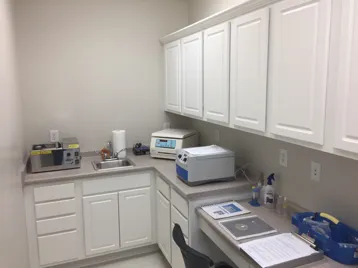
In dogs, stem cells and other regenerative cells are obtained from a short minor surgical procedure to collect the subcutaneous/ abdominal adipose tissue (fat) or a bone marrow aspirate to harvest the needed cells. The cells are then processed in the laboratory and prepared for injection back into the patient at the precise site of injury.
Over the past six years, the use of amniotic membrane‐based products for humans has grown due to innovation in preservation and storage that do not alter the biological characteristics of the amniotic material. No adverse side effects in any transplant hosts have been reported as a result of the utilization of such membranes and fluids, known as a transplant allograft. Multiple studies have demonstrated in veterinary medicine the compelling evidence in recent studies of the acceleration of wound, bone, joint, and and tendon healing. Our clinic will be conducting ongoing evidence based clinical trials to assess the healing properties of amnion as well as, investigate its use with acupuncture injection techniques to delivered to the actual site of injury.
The mechanisms by which these regenerative and stem cells initiate change within the body is very complex. When an injury occurs, chemical signals and pathways are created that lead stem cells to the area of trauma. The stem cells (Pericytes) release growth factors and other chemicals that provide local healing, reduce inflammation and promote tissue regeneration.
Which dogs are good candidates?
- Dogs that have not responded to non-steroidal anti-inflammatory drugs
- Dogs that cannot tolerate non-steroidal anti-inflammatory drugs
- Dogs that are not good candidates for orthopedic surgery
- Dogs that have early arthritis
- Dogs that have multiple joints affected by arthritis
“Dugan” A Service Dog With Severe Degenerative Arthritis
Dugan, my 12 year old assistance Labrador mix, has really struggled with arthritis, especially in his left elbow and hind end. We did stem cell treatment and PRP with Dr. Gerardi in June 2013 and it seemed to breathe more life into his aging joints. More recently, in December 2013, we did another PRP treatment and really tried to get into his hip joints and shoulders and followed it up with laser treatment on his spine. I have seen such a great improvement in his movement, disposition, and quality of life. His back end is still weaker and he still limps on his elbow but he is not nearly as stiff and seems to be in much less pain. Dugan has always been playful and goofy but that gradually got tempered as the arthritis increased. I have seen a dramatic difference in his mood and my ‘puppy dog’ is back! One important observation is that I noticed he is able to walk further and pace with me and my wheelchair again. For a long time he had trouble going only halfway around my apartment complex before his hind legs would start shaking with fatigue and I would have to slow down. He is back to being able to keep up with me and go around the whole circle without fatiguing. These treatments have really helped Dugan still be Dugan. He still limps and can’t quite keep up with the young dogs (as he got a strong dose of that reality on Christmas from a big Lab named Jake lol) but these treatments have helped Dugan get back to himself and if I can have a few more years of the joy he gives me I will take it!
– Kimberly and Dugan
“Dugan” 21 Days Post Stem Cell Treatment
“Dugan” 6 Weeks Post Stem Cell Treatment
“Dugan” 90 Days Post Stem Cell Treatment
“Dually”, A 4 Year Old Mastiff With An Acute Injury
“Dually” Pre Stem Cell Treatment of Acute Injury
“Dually” 14 Days Post Stem Cell Treatment
“Dually” 90 Days Post Stem Cell Treatment
Hospitals for After-Hour Availability
Emergency Pet Hospital of Craven-Carteret
1301A E. Main St
Havelock, NC 28532
252-444-1399
Swansboro Animal Hospital Emergency and Trauma Center
130 Phillips Loop Rd
Swansboro, NC 28584
910-839-5934